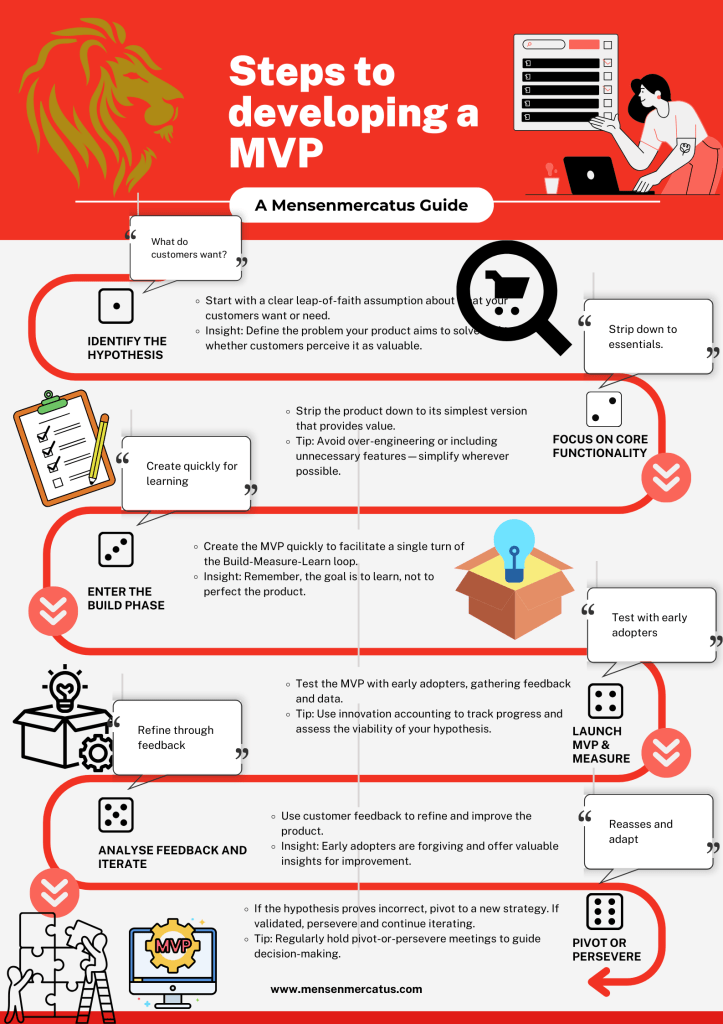
read untill the end to receive a step-by-step plan to a MVP
The Minimum Viable Product (MVP) is the cornerstone of the ´Lean methodology´, enabling quick learning and allowing startups to outpace competitors. An MVP is an overly simplified version of a product or service designed to test customer opinions and fundamental business hypotheses while delivering real value to early adopters. It facilitates quick entry into the Build phase and enables startups to measure its impact with minimal effort and development time. By selling prototypes and analysing customer feedback, startups can avoid building something nobody wants. The MVP propels the loop of Build-Measure-Learn, ensuring iterative improvements.
Why Use the MVP Methodology?
The MVP methodology ensures startups avoid wasting time and resources on building something nobody wants. It focuses energy exclusively on outcomes that customers find valuable. By testing hypotheses through functional prototypes, startups can validate or refute ideas while building an empirical foundation for future development. MVPs enable teams to iterate and adapt quickly, avoiding stagnation and unlocking significant growth potential.
Early Adopters and Their Role in MVP Development
Early adopters play a critical role in testing and validating MVPs. These individuals prefer imperfect solutions because they value being the first to use new technology. They use imagination to fill gaps in the product and provide essential feedback. To appeal to early adopters, startups must avoid feature overload, as every unnecessary addition becomes waste. Early adopters’ insights create a roadmap for scaling, allowing startups to focus on what works.
Implementing the MVP
Successful startups have demonstrated the power of MVPs through real-life examples. Dropbox’s initial MVP was a simple video showcasing its functionality, while others engaged directly with small customer groups to refine their solutions. Concierge-style services, where founders personally assist early adopters, help startups learn and scale incrementally. Iterative testing with mock-ups, prototypes, and simulations ensures products are aligned with customer needs. Remove features or processes that don’t contribute directly to learning, and use Net Promoter Scores (NPS) to assess engagement.
Get your copy on AMAZON
 mens en mercatus
Plaats een reactie